
Medication Safety at Home: A Practical Guide for Adults and Families
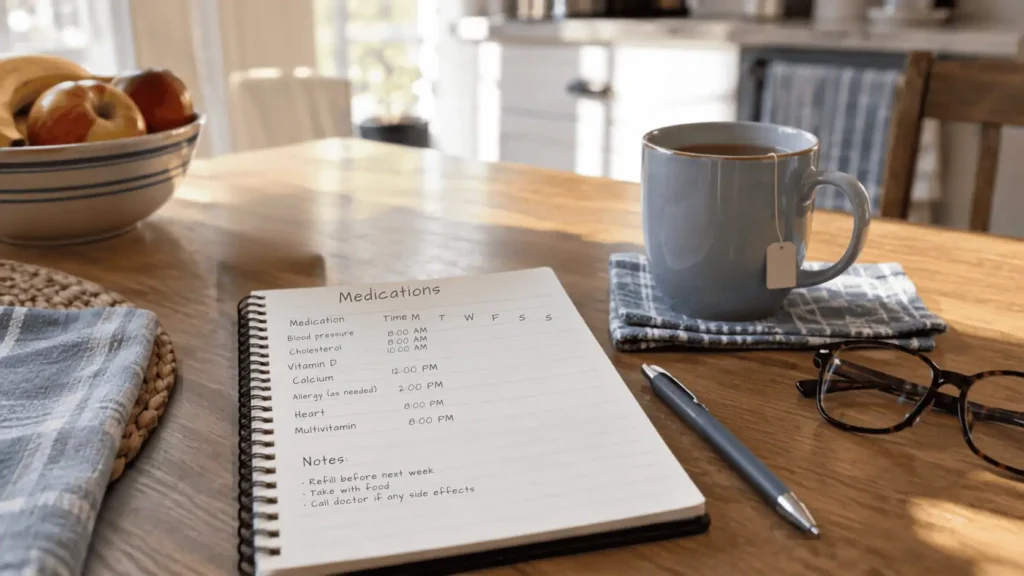
August 31 is International Overdose Awareness Day, an important reminder that medication safety deserves attention everywhere, including at home.
Not every medication mistake is an overdose. Sometimes the problem is much more ordinary:
- A prescription taken twice because no one remembers whether the first dose was taken.
- A medication that changed after a hospital stay.
- An old bottle that never left the cabinet.
- Several prescriptions from different doctors without one complete list showing everything a person takes.
These mistakes are usually not about carelessness. Medication routines can quickly become complicated, especially when health needs change.
This isn’t only an issue for older adults. Medication safety matters for adults recovering from surgery, people managing chronic conditions or disabilities, and anyone taking multiple prescriptions or relying on someone else to help keep the routine straight.
The good news is that a few consistent systems can reduce much of the uncertainty.
Why Medication Safety at Home Matters
The Centers for Disease Control and Prevention reports that adverse drug events cause more than 1.5 million emergency department visits in the United States each year, with almost 500,000 resulting in hospitalization.
An adverse drug event can include a medication error, taking too much medication, a harmful side effect, or an allergic reaction. The risk can increase as the number of medications grows, but it’s not just about age. Anyone coordinating several prescriptions, over-the-counter medicines, supplements, changing instructions, and multiple prescribers has a lot to track.
That is why medication safety at home works best when it depends on a system rather than someone’s memory.
What Are the Most Common Medication Mistakes at Home?
In homes we’ve supported across Baltimore, the problems are often surprisingly ordinary.
The doubled dose. Someone isn’t sure whether the morning medication was taken, so another dose is taken “just in case.”
The prescriber gap. A primary care doctor prescribes one medication and a specialist prescribes another, but no one has reviewed the complete list together.
The over-the-counter blind spot. The prescription list is carefully maintained, but no one mentions the daily pain reliever, antacid, vitamin, herbal supplement, or other nonprescription product.
The old bottle. A medication has been discontinued, or the dose has changed, but the previous bottle is still sitting beside the current one.
The post-hospital reshuffle. Someone comes home with new instructions after a hospital or rehabilitation stay, but the medications already in the house have not been compared with the new discharge list.
None of these situations requires irresponsibility. They happen because medication routines can become confusing, particularly when several people are involved in someone’s care.
Keep One Complete Medication List
One of the most useful things a family can do is create a single, up-to-date medication list.
Gather everything the person regularly takes, including:
- Prescription medications
- Over-the-counter medicines
- Vitamins and supplements
- Inhalers
- Eye drops
- Creams and ointments
For each item, record the name, dose, when it is taken, what it is used for, and the prescribing doctor when applicable. Include known medication allergies and the date the list was last updated.
Keep a copy somewhere easy to find. It can also help to have a trusted family member keep a photo or electronic copy on a phone. If an unexpected trip to the emergency department happens, having an accurate list available can save a lot of guessing at exactly the wrong time.
The list only works, however, if someone updates it. When a medication is started, stopped, or changed, change the master list too.
Review Medications After a Hospital Stay
Coming home from the hospital is one of the easiest times for medication confusion to begin.
A person may leave with a new prescription, a different dose of something they were already taking, instructions to stop another medication, or a temporary medicine needed only during recovery.
Meanwhile, the old bottles are still waiting at home. That is why you should carefully compare the medication list from the hospital or rehabilitation facility with what was taken before the stay.
The Agency for Healthcare Research and Quality describes this process as medication reconciliation: comparing medications across transitions in care so differences can be identified and clarified.
For families, the practical version is simple: do not assume the medications in the cabinet still match the instructions that came home from the hospital. If anything is unclear, contact the prescribing healthcare professional or pharmacist before guessing.
A hospital discharge already gives families enough to manage. Uncertainty about medications should not be another problem left to chance.
Ask for a Medication Review
Bring the complete medication list to medical appointments and ask a straightforward question: “Is everything on this list still necessary, and is there anything here that should not be taken together?”
Routine appointments often focus on the immediate reason for the visit, so it is worth specifically asking for a medication list review.
A pharmacist can also be an important resource. Pharmacists can answer questions about how to take medications, potential interactions, side effects, storage, and other concerns. Ask your pharmacy what medication review services are available.
When possible, using one pharmacy for prescriptions can also make it easier for the pharmacist to see the overall prescription picture and identify potential concerns. If you have questions about whether to stop or change a medication, ask the prescriber. Some medications should not be discontinued abruptly.
Use a Medication Routine That Does Not Rely on Memory
Memory is the wrong tool for this job—for anyone, at any age. A good medication routine should make it easy to answer one basic question: Was this medication taken or not?
Depending on the person’s needs and the instructions for the medication, that system might include:
A weekly pill organizer. For some medication schedules, an organizer with separate morning, afternoon, or evening compartments can make the routine easier to see. Ask the pharmacist before removing medications from their original packaging if you are unsure about storage requirements.
A written checkoff sheet. Marking each dose when taken removes the uncertainty that often leads to accidental double dosing.
Phone alarms or reminders. The CDC recommends timers or reminders as one way to help people take medication on schedule.
Routines connected to familiar parts of the day. When the medication instructions allow it, connecting a reminder to breakfast, bedtime, or another regular routine can be easier to follow than relying only on the clock.
Clear communication between family members. If more than one person helps with medications, everyone needs to know what has already happened. “I thought you gave it to her” is not a system.
The best setup is usually the simplest one that everyone involved can follow consistently.
Clear Out Medications That Should No Longer Be There
Unused, expired, and discontinued medications can create avoidable risk when they remain in the home. A bottle from six months ago can look a lot like the current one, especially when someone is tired, rushed, has low vision, or is dealing with memory changes.
The U.S. Food and Drug Administration (FDA) recommends medication take-back programs as the preferred way to dispose of most unused or expired medications.
Baltimore City has free medication disposal locations, and the Drug Enforcement Administration (DEA) also maintains a searchable locator for authorized collection sites. Because locations and accepted items can change, check the current information before making a trip.
If a take-back option isn’t readily available, follow FDA disposal instructions for that particular medication rather than automatically flushing it or putting it in the trash.
Consider checking the medicine cabinet regularly, perhaps twice a year, rather than waiting until it becomes crowded with medications nobody is using.
What Should You Do if Someone May Have Taken Too Much Medication?
If someone may have taken an extra dose, the wrong medication, or an uncertain amount, do not guess about whether it is dangerous and do not wait for symptoms to appear.
In the United States, Poison Control provides free, confidential guidance at 1-800-222-1222.
Have the medication container available, if possible, so you can provide the exact name, strength, and other information. If the person collapses, has a seizure, has trouble breathing, or cannot be awakened, call 911 immediately.
A double dose of one medication may cause little harm while the same mistake with another medication can be serious. That determination is best left to a medical or poison-control professional.
When Medication Reminders Need Another Set of Hands
Sometimes the problem is not the medication organizer. It’s that one person has become responsible for keeping the entire system running: every dose, every refill, every appointment, every medication change, and every new instruction that comes home from the doctor’s office. That’s a lot to carry every single day.
A family caregiver may be doing all of this while working, raising children, managing a household, or coordinating care from another part of town. The medication routine may be only one item on a much longer list.
There may come a point when missed or uncertain doses are becoming more common, confusion is affecting the daily routine, someone is recovering from a hospital stay, or a family member just can’t be there every time a reminder is needed.
That is when consistent in-home support can help.
At Esther’s Home Care, medication reminders can fit into a broader daily care routine. The same caregiver who knows when breakfast usually happens, how the morning tends to go, and whether something seems different that day can also provide the agreed-upon reminder at the appropriate time.
That consistency matters.
Our caregivers do not prescribe medications or decide when dosages should change. Those questions belong with the client’s healthcare professionals. Our role is to help make the daily routine more dependable while providing the personal care, companionship, household support, respite care, post-hospital support, or extended care the person may also need.
Esther’s Home Care works with adults of all ages throughout Baltimore City, Catonsville, and Pikesville. Whether the need comes from aging, a chronic condition, a disability, or recovery after a hospital stay, the goal is the same: reliable support that makes daily life safer and more manageable for the person receiving care and the family trying to hold everything together.
If medication reminders are one of the pieces that keep slipping at home, call 443-522-1535 to talk with us about what kind of support may make sense.
How can families reduce medication mistakes at home? Start with one accurate medication list and a routine that makes it clear whether each medication has been taken. Keep prescriptions, over-the-counter medicines, vitamins, and supplements on the same list, and update it whenever something changes.
What information should be on a medication list? Include the medication name, dosage, schedule, reason for taking it, prescribing doctor when applicable, known medication allergies, and the date the list was last updated. Include over-the-counter medications and supplements as well as prescriptions.
Why should medications be reviewed after a hospital discharge? Hospital stays often result in medications being added, stopped, or changed. Comparing the discharge medication list with what is already at home can help identify differences that need clarification from the healthcare team or pharmacist.
Can an in-home caregiver help with medication reminders? Yes. Depending on the care plan and applicable requirements, an in-home caregiver can provide medication reminders as part of a consistent daily routine. Questions about prescribing, changing dosages, interactions, or stopping medications should be directed to the appropriate healthcare professional.